| |
-
When more scientists and more members of the public learn that animals have rich emotional lives, then perhaps society will do more to find alternatives to animals for biomedical research.
—Marc A. Bekoff
A lonely dog? A grief-stricken elephant? A desperate cow? A loving gorilla?
While most pet owners believe that animals feel a range of emotions, including love, compassion, anger, stress, disappointment, and ecstasy, scientists remain skeptical about the existence of animal emotions. They say that emotions are intangible and impossible to prove using standard scientific methods. Today, however, many people in the scientific community are stepping forward to assert that animals do have feelings.
People who enjoy the company of animals usually have much to say about the way that animals express their emotions. Some of these feelings seem to be very much like our own, but in addition to shared emotions, animals may experience a range of feelings that we cannot easily understand.
Sensitivity
As Jeffrey Masson points out, animals are other. They are not the same as human beings. He writes:
After a lifetime of affectionate regard for dogs and many years of close observation and reflection, I have reached the conclusion that dogs feel more than I do (I am not prepared to speak for other people). They feel more, and they feel more purely and more intensely. By comparison the human emotional landscape seems murky with subterfuge and ambivalence and emotional deception, intentional or not.[1]
Dogs, for instance, have a depth of sensitivity that is hard for most people to understand. One moment, sensing that they might be going for a walk, they break out into a celebratory dance. And the next moment, they might be stricken with despair when told that they cannot accompany their human companion on an outing.
Masson comments that perhaps the word "no" is too harsh for dogs to hear. Perhaps that word should never be used with a dog, for it is simply too devastating. It is not that the concept is unknown to dogs, but somehow, when they hear that terrifying sound from their beloved friends, they enter a kind of gloom from which it can seem unlikely they will ever emerge.
Of course, minutes later, they do emerge — and that is something else I love about dogs. While they experience an emotion to its full potential, once it is over, that is that, and they are ready for the next experience. Dogs do not seem to waste time brooding over the past or anxiously awaiting the dreaded future. They are always present.[2]
Love and compassion
If we limited our understanding of animals to the research done by scientists in laboratories, we would cut ourselves off from the knowledge gained by people who share their daily lives with animals. Kristin von Kreisler, author of The Compassion of Animals, has collected hundreds of true stories about the virtuous ways that animals behave. Many of the stories describe the comfort that animals give to people who are sick or dying.
One of my favorite stories in von Kreisler's collection is about Lulu, a 209-pound pig who lives in Beaver Falls, Pennsylvania. Von Kreisler explains that Lulu looked like a giant, hairy mushroom with a thick gray hide and spindly legs. But when Jo Ann Altsman, her guardian, had a heart attack, Lulu came to the rescue.
Jo Ann was home alone at the time. She lay terrified, sprawled on the floor. She didn't think she could get up to dial 9-1-1 — making any kind of physical effort in her condition seemed even more life-threatening than her circumstances already were. Certain that she was going to die alone with no one to help her, Jo Ann started to pray. In her mind, her whole life paraded before her, and she began to cry.
Then Lulu waddled over to Jo Ann and started crying, too. "Big fat tears were running down her snout and dripping off it," Jo Ann remembers. "The more I cried, the more she kept putting her head over me and making terrible sobbing sounds. She kept trying to kiss me."[3]
Lulu was so concerned about Jo Ann that she wriggled through a tiny door made for a twenty-five-pound dog! Lulu could barely get through the door, and cut herself as she made her way outside in search of a neighbor who might be able to help Jo Ann. She went in and out of the door several times to check on Jo Ann, each time shedding more tears as she looked at her. Each time she went through the door, she received more cuts from the tight squeeze.
Finally, Lulu unlatched the front gate with her snout and made her way into the road where she was able to summon the attention of a driver, who stopped, found Jo Ann, and called for an ambulance.
In another story, von Kreisler describes the remarkable behavior of Dakota, a service dog that a doctor had "prescribed" for Mike Lingenfelter to help him recover from depression. The dog was such an enormous boost to Lingenfelter's morale that he started to take him to various schools with him when he lectured on pet care.
On one such visit, though, the dog suddenly whined, paced, and poked his nose against his guardian's leg with great agitation. Says Lingenfelter, "I was embarrassed because I'd just been talking with the students about how service dogs are so well behaved." Dakota started barking, and Lingenfelter led him out of the classroom. Once out in the hall, Lingenfelter, who had a chronic heart condition, sank to the floor with a heart attack.[4]
There were other occasions after this when Dakota sensed that Lingenfelter was having heart trouble. Lingenfelter believes that his dog was able to sense changes in the smell of his sweat caused by the release of enzymes when his heart began to malfunction.
Dakota also was able to sense when other people had health problems. One day he rushed into the office of Lingentelter's colleague. He barked and whined, and moments later the man had a heart attack.
Von Kreisler describes many other stories of animals who care for humans, including that of a Labrador retriever who had been a stray until Marty Rosenblum took him in. "Plywood" loved to roam the neighborhood and started making regular visits to a man with terminal cancer. He would show up at Jim Dunn's house in the morning and leave in the late afternoon. Dunn appreciated the visits and was comforted by Plywood's presence.
On the day that Dunn died, Plywood was unable to get into the locked house, so he pushed his way through a screen door in order to sit with Dunn. The family understood the importance that Plywood had in Dunn's life and put a photo of the dog in his casket.
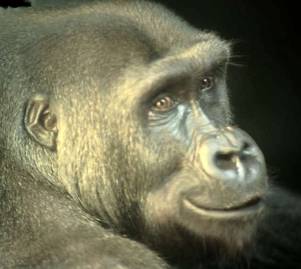
Another story of compassion was reported in Time magazine. In 1996, Time voted Binti Jua, an eight-year-old western lowland gorilla, one of the "best people" of the year. Binti was on display in the primate exhibit at Chicago's Brookfield Zoo. He had saved the life of a three-year-old boy when he scooped him up and carried him to safety after the boy fell six meters and landed in the exhibit. The gorilla cradled the boy in her lap and gently patted his back, then sat with him on a log in a stream. Her act of kindness and compassion touched the hearts of all those who heard about her and she became an overnight celebrity.
Joy
Charles Darwin wrote, "Happiness is never better exhibited than by young animals, such as puppies, kittens, lambs, &c., when playing together, like our own children."
Almost all young mammals enjoy playing by themselves or with others. Dolphins often frolic in the water, and Jane Goodall speaks of chimpanzees that chase each other and pirouette around one another.
Marc Bekoff describes animals at play as symbols of the unfettered joy of life. In a moving passage, he describes the sensation of watching a young elk playing in the snow.
My body tingled with delight as I once observed a young elk in Rocky Mountain National Park, Colorado, running across a snow field, jumping in the air and twisting his body while in flight, stopping to catch his breath, and then jumping and twisting over and over and again. There was plenty of grassy terrain around but he chose the snowfield. Buffaloes will also follow one another and playfully run onto and slide across ice, excitedly bellowing "Gwaaa" as they do so.[5]
Stress, anguish, and fear
Animals also share another human emotion with humans: stress. Robert Sapolsky and his colleagues at Stanford University have been carrying out a study in East Africa's Serengeti Plain of the factors that contribute to stress among baboons. They believe that baboon troops are a high-stress society where higher-ranking baboons intimidate lower-ranking troopmates to maintain order. Their research shows that baboons are not so different from us, since they can devote a large part of each day to making each other absolutely miserable with social stress.
Animals also feel fear and anguish at facing death, and struggle to preserve their existence. The true story of Emily illustrates the anguish that a three-year-old Holstein cow felt when it was about to be slaughtered in Hopkinton, Massachusetts.
Emily had seen her companions pass through a swinging door in front of her, never to return, and she was next in line to be slaughtered. She had never been in a slaughterhouse before, and there was no way out for her since a five-foot fence confined her in a small area.
Emily was lucky. Just as her turn came up, the men took a lunch break. Emily seized upon the moment and took the opportunity to escape. Somehow, this 1,600-pound cow jumped over the five-foot fence. No one had ever heard of a cow doing this kind of thing before, and she soon became known throughout the rural area west of Boston, where a search party tried to find her. The slaughterhouse workmen scoured the woods and endeavored to entice her back by leaving bales of hay for her, but she would not go near the traps that they set.
Many people reported seeing Emily running through the woods. Some even saw her learning to forage for food with a herd of deer. The newspaper reported updates on recent sightings of Emily, and when Meg Randa read about her, she felt determined to purchase her from the slaughterhouse so that she could live in peace on Randa's land.
The Randas searched the woods and left food for Emily. But although Emily ate the grain, hay, and water that they left for her, she did not reveal herself to them.
After numerous attempts, they finally found her in the woods, looking right at them. She had lost 500 pounds and needed the care of a veterinarian to recover from her 40-day ordeal. Eventually, she was taken to Randa's schoolhouse, where she is being tended by the students.[6]
Mourning
In addition to animals' feeling anguish about their own death, they mourn the death of those who have been close to them. Countless cases of elephants mourning the loss of dead or dying family members have been reported. Elephants have been known to stand beside an animal's remains for long periods of time. Joyce Poole, a Kenyan biologist, asserts that elephants have deep emotions at the loss of a family member and that they have some understanding about death.
There are many documented examples of interspecies love, where animals mourn the death of their companions. Sometimes they refuse to eat, endangering their own lives. Sometimes they die soon after the loss of a beloved friend.
In Tokyo, an Akita kept a ten-year vigil at a train station, waiting for his dead owner to return.
Attachment through morphic fields
In his book Dogs that Know When their Owners are Coming Home: And Other Unexplained Powers of Animals, Rupert Sheldrake discusses hundreds of cases of animals that can sense when their owners are coming home, animals that can find their way home over unfamiliar terrain, and cats that know when their owners are calling.
Sheldrake suggests that animals respond telepathically to human intentions and are bonded to people through morphic fields.
Morphic fields, he says, link members of social groups and can continue to connect them even when the individuals are far apart. These invisible bonds act as channels for telepathic communication between animals and animals, people and animals, and people and people.[7]
These links, acting like invisible elastic bands, also underlie the sense of direction that enables animals and people to find each other. He writes about dogs, cats, and even parrots who anticipate their owner's arrival.
Pepper is a young Amazon parrot who lives in Pennsylvania. He belongs to Dr. Karen Milstein and her husband, Philip, to whom the bird is closely bonded. "Our bird frequently starts calling 'Hello' and calling my husband by name shortly before he arrives home, even though the time may vary significantly from day to day."[8]
Expressing emotions through gestural words
Dr. Francine Patterson began working with Koko, a female lowland gorilla, in 1972, when Koko was one year old. Today, Koko uses over a thousand gestural words to communicate her feelings and thoughts, and she is able to understand two thousand words of spoken English. She can construct sentences using three to six words. Her IQ is between 70 and 95 on a human scale where 100 is considered normal.
The Koko project involves "the study of innovative linguistic strategies, invention of new signs and compound words, simultaneous signing, self-directed signing, displacement, prevarication, reference to time and emotional states, gestural modulation, metaphorical word use, humor, definition, argument, insult, threat, fantasy play, storytelling and moral judgment. The depth and variety of gorilla language use has significantly exceeded initial expectations. Indeed, evidence has been found for the existence, in less developed form, of almost every aspect of human behavior."[9]
Koko uses signs to rhyme, joke, lie, and insult. Penny Patterson notes:
For example, the day after Koko bit a companion, I asked her, "What did you do yesterday?"
She replied, "Wrong, wrong."
"What wrong?" I queried.
"Bite."
The following conversation took place three days after the event discussed:
Koko: Bite.
Penny: You admit it? (Previously Koko had referred to the bite as a scratch.)
K: Sorry bite scratch. (I show Koko the mark on my hand — it really does resemble a scratch.)
K: Wrong bite.
P: Why bite?
K: Because mad. (A few minutes later it occurs to me to ask Koko. . .)
P: Why mad?
K: Don't know.[10]
Dr. Patterson finds this example of importance because Koko makes reference to a past emotional state. She speaks of her anger, though she isn't actually experiencing it in the moment. This is significant because it means she can separate affect from the context of her utterances.
Koko often reports on her feelings. She informs her companions that she is happy, sad, tired, or afraid. Once when Koko avoided playing with another gorilla, Dr. Patterson asked if she were afraid of something. Koko had always been afraid of lizardlike creatures and toys and said that he was, "Afraid alligator."
Emerging scientific evidence for emotions in animals
The study of the biology of animal emotions is a field that is still in its infancy. It is clear that scientists are finding many similarities between the human brain and animal brain. In humans and animals, emotions seem to arise from the cortex, an ancient part of the brain.
The case for animal emotions also is bolstered by recent studies of brain chemistry. Steven Siviy, a behavioral neuroscientist at Gettysburg College in Pennsylvania, has found that when rats play, their brains release copious amounts of dopamine, a neurochemical that is associated with pleasure and excitement in humans.
In one experiment, Siviy placed pairs of rats in a distinctive Plexiglas chamber and allowed them to play. After a week, he could put one animal alone in the chamber and, anticipating its upcoming play session, it would become "very active, vocalizing, and pacing back and forth with excitement." But when Siviy gave the same animal a drug that blocks dopamine, all such activity came to a halt. Neuroscientist Panksepp has found evidence that rats at play also produce opiates, chemicals that, like dopamine, are thought to be involved with pleasure in people.[11]
Bekoff notes that if dopamine makes a human feel good or happy, it is doing the same in a dog or a rat, because the neuroanatomy and neurochemistry of humans and other vertebrates are similar.
Implications for animal rights
Jane Goodall made the comment that scientists who use animals to study the human brain, then deny that animals have feelings, are being "illogical."
Dr. Patterson asserts that knowledge of animal feelings is of extraordinary importance in terms of animal advocacy efforts. When people understand that animals possess qualities that they had previously considered exclusively human, she feels, then they will be more inclined to treat animals kindly and become concerned with the preservation of endangered species.

Top of Page
 Print Version
|
|
|